
“Education is the most powerful weapon which you can use to change the world.”
~ Nelson Mandela
Process Overviews
Mentoring Journey
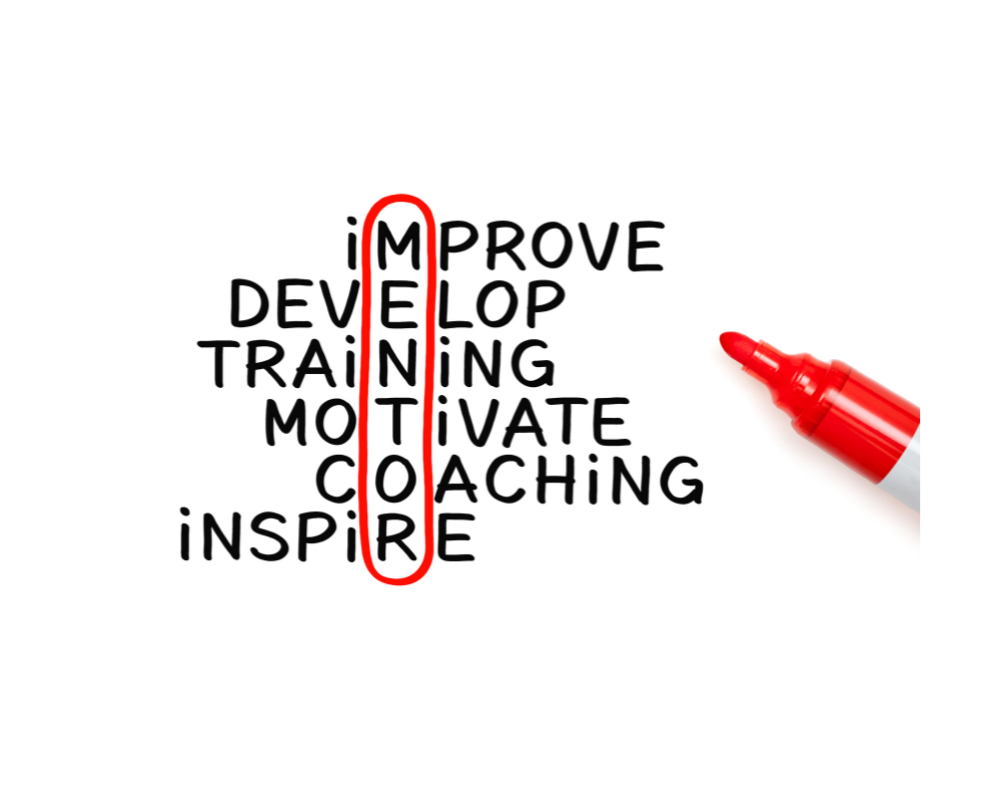
Deliver Asha’s mentoring journey spans four years of high school. Mentees begin the journey in their freshman year and complete it upon graduation in their senior year.
The learning objectives, case study materials, and key activities for mentoring workshops are tailored to provide students with relevant and useful information appropriate to their grade level.
Beginning in the sophomore year, mentors and mentees meet one-on-one at the start of each school year to reflect on the previous year’s progress and challenges and to review any changes in academic or career interests.
The outline below provides an overview of the key objectives for the mentoring workshops each year.
Freshman year:
- Lay the foundation for building an authentic, trusted, long-term mentor-mentee relationship.
- Acclimate mentees to the high school environment and raise awareness of available services, including guidance counselors and clubs.
- Explore mentees’ personal values, hobbies, academic and extracurricular interests, and learning challenges in greater depth, including discussing strengths and areas of growth.
- Create a personalized Mentoring Journey Map that outlines ideas mentors could incorporate into workshop lesson plans to tailor the experience for each mentee.
- Conduct workshops on foundational skills that translate into effective study habits, time management, and awareness of how personal values and beliefs shape everyday choices.
Sophomore year:
- Conduct workshops to practice the five essential skills for managing everyday situations in line with personal values.
- Organize field trips to local businesses, industries, and organizations to observe how employees and team members collaborate to achieve the company’s mission.
- Invite guest speakers from local organizations to share their views on how they have observed the 10 core life traits apply to their personal and professional roles.
Junior year:
- Conduct workshops to raise awareness of key factors to consider when exploring postsecondary education options, including preferred specialization, school location, and career interests.
- Conduct workshop sessions that explore different career paths and their associated education, skills, job outlook, and compensation ranges.
- Conduct workshop sessions on the importance of networking and cultivating professional connections.
- Conduct workshops to identify community improvement projects and develop project plans to implement them.
Senior year:
- Conduct workshops to prepare mentees for life after graduation, focusing on financial literacy and decision-making strategies that promote long-term thinking.
- Conduct workshops to encourage mentees to build support networks aligned with their values and interests beyond high school.
- Execute plans to implement community improvement projects identified in Junior year.
- Review the four-year mentoring experience, highlighting key moments, and gather suggestions to improve the program for future mentees.
Inquiry-Based Learning
Inquiry-based learning (IBL) is a student-centered approach in which the teacher shifts from lecturing to facilitating. The teacher provides the question, process, and materials, and students follow the steps. Teachers support the process by offering guidance and resources.
The IBL approach encourages students to develop critical thinking, problem-solving, and independence by shifting from rote memorization to active exploration, often through hands-on activities and group projects that enhance learning.
This approach also promotes student responsibility for their learning by prompting them to ask questions, investigate real-world problems, and deepen their understanding through hands-on experimentation and discovery. Rather than passively absorbing facts, students gain knowledge through active engagement.
Jigsaw Method
The jigsaw method is an effective interactive learning technique developed by Elliot Aronson. The Jigsaw method promotes student interdependence and individual accountability, fostering a deeper understanding of the topics or problems discussed.
Deliver Asha mentoring workshops using the jigsaw method, feature case studies that incorporate three or four learning objectives that strengthen a combination of our 10 traits.
Assuming there are 16 students in the workshop, and the case study has four topics/learning objectives, the mentoring workshop process using the jigsaw learning method would involve:
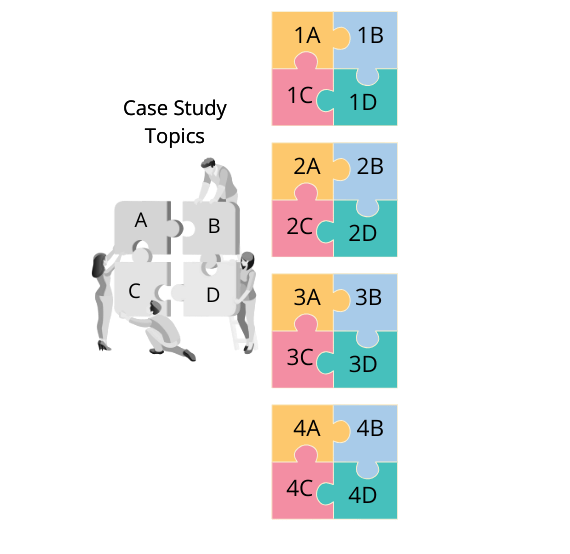
Stage 1: Form Home Group & Assign Topic/Learning Objective
- Mentors divide the total number of students into four “home groups” of four students per group.
- Each member of a home group is then assigned a distinct topic/learning objective from the four.
- The students with the same topic/learning objective from each home group form new groups. Groups of four students with the same assignment are called “expert groups.”

Stage 2: Expert Group Review & Analysis of Assigned Topic/Learning Objective
- The “expert groups” study and discuss their assigned topic in depth.
- To ensure each student can confidently share their understanding of the assigned topic with the other students in their original home group, they prepare notes and practice presenting their knowledge.
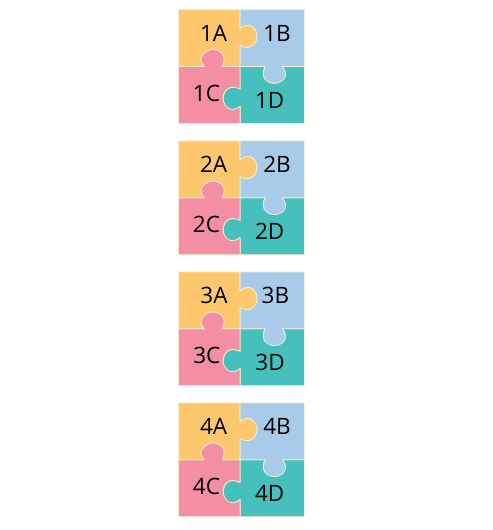
Stage 3: Return to Home Group & Share Knowledge of Topic/Learning Objective
- Once the “expert group” members are knowledgeable about their assigned topic, they return to their original home groups to share what they’ve learned.
- The other students in the home group (with different assigned topics) are encouraged to ask questions for clarification as needed.
- Mentors observe the presentations and ask open-ended questions to encourage discussion, helping everyone gain a clear understanding of the learning objectives.
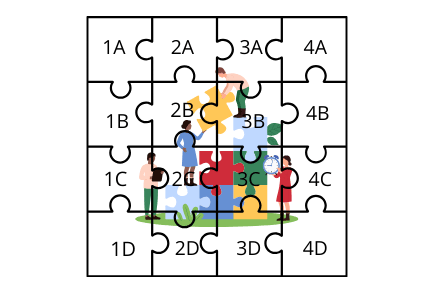
Stage 4: Jointly Verify Learning Objectives Are Achieved and Wrap-up
- In the final step, the entire class of 16 students reconvenes, and mentors facilitate structured discussions to help students from each home group ask clarifying questions of students from other groups. This step helps eliminate misunderstandings and fosters a shared understanding of the topics and related learning objectives among all participants.
How are the principles of the Jigsaw method applied to field trips?
Assuming the field trip includes 12 students, before each trip, three “home groups” are formed, each with four students. Each student in a home group is assigned one of four topics to become an expert on during the field trip. Their task is to learn as much as possible about their assigned topic and share that knowledge with their home group upon returning from the trip.
Students are provided with clipboards and notebooks containing guiding questions for their assigned topics. They are encouraged to take notes and ask the hosts questions to deepen their understanding.
Each field trip schedule includes a short break, allowing students from different home groups working on the same topic to form an expert group, compare notes, discuss initial observations, and clarify any issues before the trip ends.
After the field trip ends, each student in the expert group reviews their notes and prepares a presentation on the assigned topic. Then, the students in the expert group meet to share their presentations, clarify any confusion, and plan how to present their learning in a clear and concise way.
Next, the students reconvene with their original home groups to present their expertise on assigned topics. While one student presents, others take notes and ask questions to clarify understanding. Mentors facilitate the discussion, ensuring everyone is involved and contributing to the learning goals.
Finally, all students work together to create a physical or digital scrapbook that highlights their experiences and key takeaways from the trip. This step helps reinforce what they learned during the field trip.
Guides
Deliver Asha mentors use the following self-discovery guides to establish a baseline understanding of the values, beliefs, and biases that influence a mentee’s decisions and actions.
These freshman-year exercises provide mentors with insights that help personalize and monitor the mentoring experience for mentees from the start of their four-year high school mentoring journey.
Values
Exercise to prompt self-reflection on core values.
Beliefs
Exercise to prompt self-reflection on belief system.
Biases
Exercise to prompt self-reflection on implicit biases.
To introduce learning objectives aligned with the ten core traits, mentors use case studies to facilitate inquiry-based learning with the jigsaw method.
Sample Jigsaw Case Study
The Piston Cup, Route 66, and the Power of the “Pit Crew”
Useful Links
Deliver Asha’s strategy and approach have been shaped by the experiences of remarkable public and private sector organizations worldwide that employ innovative methods to reduce poverty. Similarly, influential books and podcasts by scholars and experts have played a significant role in shaping our initiatives.
We are grateful for their contributions, which we build on to introduce new approaches to prevent systemic, intergenerational poverty, particularly in underserved communities.
The links below direct you to websites of notable organizations, podcasts, and summaries of books on YouTube:
****
Organizations
- Boys & Girls Clubs of America
- Sudbury Valley School
- Greater Bergen Community Action
- Khan Academy
- New Avenues for Youth
- Youth Communication
- Youth Mentoring Connection
Podcasts
- Akimbo
- The Happiness Lab
- Hidden Brain
- The Knowledge Project
- Impact Boom
Books
- Braving the Wilderness – Brene Brown
-
7 Habits of Highly Effective People – Stephen R. Covey
-
Atomic Habits – James Clear
-
Creating a World Without Poverty – Muhammad Yunus
-
How Will You Measure Your Life – Clayton M. Christensen
-
Humble Inquiry – Edgar H. Schein
- IKIGAI – A Japanese Philosophy for Finding Purpose
-
Leadership and Self-Deception – Arbinger Institute
-
Mindset The New Psychology of Success – Carol S. Dwek
-
Six Thinking Hats – Edward De Bono
-
Supercommunicators – Charles Duhigg
-
Start with why – Simon Sinek
****
Inspirational Quotes
A few of our favorite quotes that have inspired and continue to inspire our efforts at Deliver Asha:
“Be the change you wish to see in the world.” ~ Mahatma Gandhi
“Education is the most powerful weapon which you can use to change the world.” ~ Nelson Mandela
“We must reject not only the stereotypes that others hold of us, but also the stereotypes that we hold of ourselves.” ~ Shirley Chisholm
“If we can imagine something, there is a good chance that it will happen. If we don’t imagine it, there is almost no chance of it happening.” ~ Muhammed Yunus
“Alone we can do so little, together we can do so much.” ~ Helen Keller
“Remember, teamwork begins by building trust. And the only way to do that is to overcome our need for invulnerability.” ~ Patrick Lencioni
“When we strive to become better than we are, everything around us becomes better too.” ~ Paulo Coelho
“The happiness of your life depends upon the quality of your thoughts.” ~ Marcus Aurelius
“Strive not to be a success, but rather to be of value.” ~ Albert Einstein
“None of us, including me, ever do great things. But we can all do small things, with great love, and together we can do something wonderful.” ~ Mother Teresa
“We must believe in ourselves or no one else will believe in us: we must match our aspirations with the competence, courage and determination to succeed.” ~ Rosalyn Yalow
“Our lives begin to end the day we become silent about things that matter.” ~ Martin Luther King, Jr
“The goal isn’t to be liked. The goal is to be trusted”. ~ Seth Godin
“You miss 100% of the shots you don’t take” ~ Wayne Gretzky
“The way to get started is to quit talking and begin doing.” ~ Walt Disney
“Our greatest weakness lies in giving up. The most certain way to succeed is always to try just one more time.” ~ Thomas A. Edison
“I’ve missed more than 9000 shots in my career… And that is why I succeed.” ~ Michael Jordan
“Whatever the mind of man can conceive and believe, it can achieve.” ~ Napoleon Hill
“Your time is limited, so don’t waste it living someone else’s life.” ~ Steve Jobs
****
Glossary
Beliefs – Assumptions we hold generally based on past life experiences that influence our current choices and actions. It could be about an issue, a topic, a person, a group, a skill, a value, etc. Beliefs can evolve over time and often do.
Bias – A bias is a prejudice either for or against a particular thing, person, or group, often viewed as unfair. Most biases are unconscious(implicit); they serve as “mental shortcuts’ that our brain uses to make quick judgments without considering all the facts.
Communities – A group of people with shared attributes whose members reside in a specific locality, have connections, share government, and usually have a common cultural and historical heritage.
Compassionate Collaboration – A process by which people strive to genuinely welcome and reward ideas from others in support of the greater good, such as playing their part in strengthening their communities.
Guiding Principles – Values and skills that serve as the foundation for a system of beliefs for routine everyday reasoning. They are fundamental beliefs that guide the actions and attitudes of individuals or groups of people within organizations.
Intergenerational – A reflection of the exchanges between generations and the impact of mutual influences among successive generations.
Opportunity Gap – A significant and persistent lack of access to high-caliber educational experiences and learning opportunities that can lead to lower success rates in educational achievement, career prospects, or attaining other life aspirations.
Poverty – The state or condition in which a person or community lacks the financial resources and essentials for a minimum threshold of material well-being.
Process – Step=by-step methods or sequence of actions to achieve a goal.
Prosperity – The state or condition in which a person feels they have the opportunity and freedom to thrive by fulfilling their unique potential.
Role Model – Someone who leads by example, whose behavior in a particular role is imitated by others.
Self-actualization – Striving to reach a state where people live up to their full potential. This potential can vary and is different for every individual.
Socioeconomic Status – Subjective perceptions of social status and social class. It encompasses not only income but also educational attainment and occupational prestige. It reflects quality-of-life attributes and opportunities afforded to people within society and is a consistent predictor of a vast array of psychological outcomes.
Systemic Poverty – A state of hardship in which individuals and families are trapped due to interconnected obstacles such as inadequate education, limited job opportunities, lack of financial resources, etc.